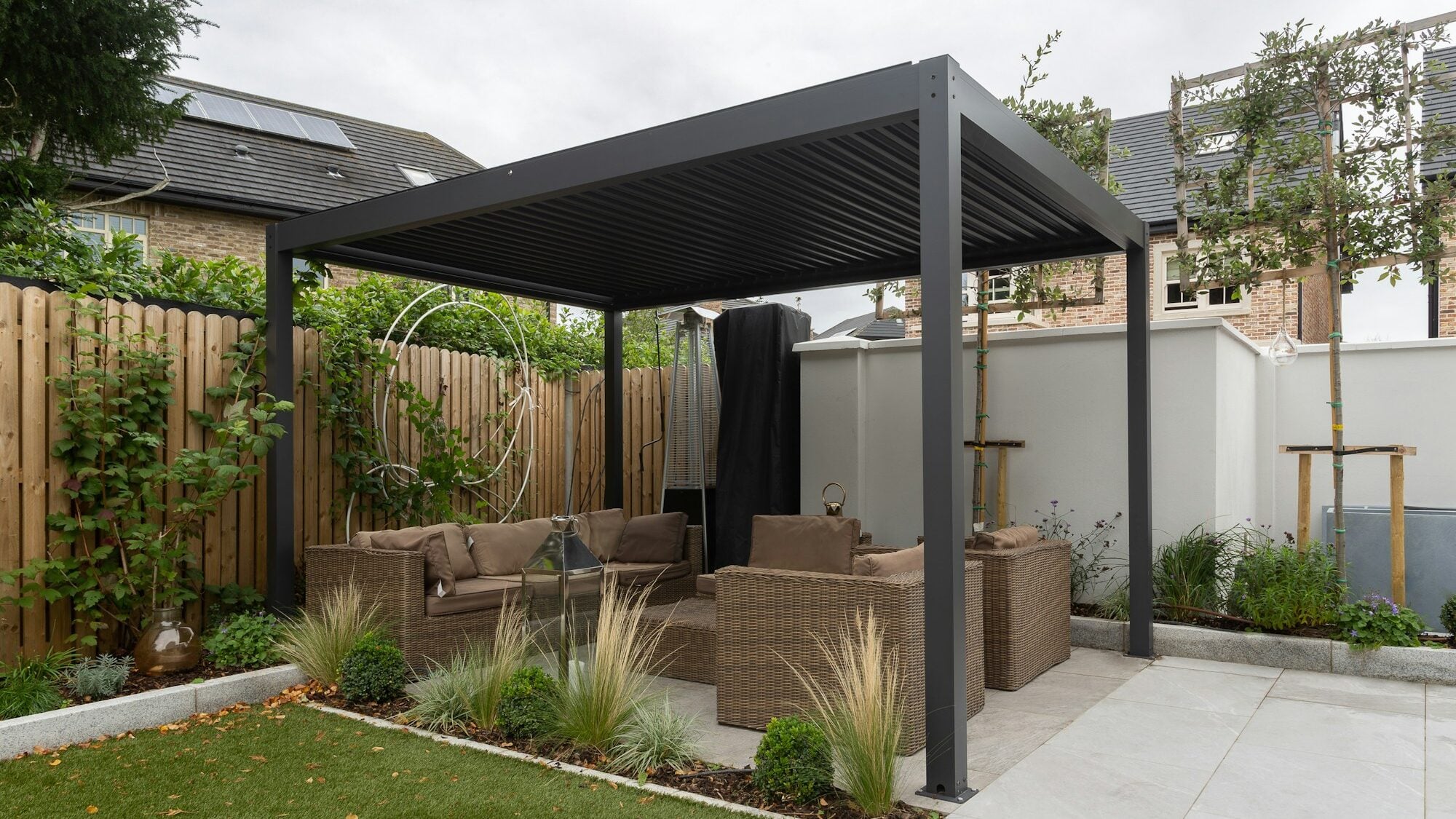


On the websites of fence, pergola and railing makers it is one of the most common things you will find: a length field, a rate per metre and a "Calculate" button. The customer types 23 metres and sees a price straight away.
It is fast, easy to understand and almost always wrong. Not because the rate is badly set. A made-to-order product simply is not priced in metres. It is priced in panels, posts, corners, gates, heights and terrain, and metres see none of them.
This article shows where exactly a price per metre breaks, why both the customer and the salesperson feel it, and what to do instead.
Where the rate per metre comes from
A rate per metre rarely comes out of nowhere. The manufacturer takes a typical panel section, adds up its price and divides it by its width.
An example with illustrative prices: the panel for a 2.5 m section costs €95, a post with its footing and cap €50. One section with one post is €145 per 2.5 metres, or €58 a metre. Rounded up, €60/m.
On an average fence that holds. But nobody orders an average fence.
Where the price per metre breaks
Take the same system and a fence 23 metres long in a straight line. The calculator shows 23 × €60 = €1,380. The real budget looks different:
calculator   23 m × €60/m                   €1,380

reality      23 m ÷ 2.5 m = 9.2 → 10 sections
             10 panels × €95                  €950
             11 posts × €50                   €550
                                            €1,500
The €120 difference appears before the first gate is even placed. A section cannot be bought in tenths, and a fence with ten sections has eleven posts, not ten. And that is the simplest case there is.
Other places where metres miss what the customer is actually ordering:
- Corners. The same fence bent into an L, 14 m and 9 m, is still 23 metres. But the sections divide differently, and the corner post is often a heavier profile.
- Gates. They are priced per piece and come with their own posts and hardware. In some systems a sliding gate changes the post profile along the whole fence.
- Height. A taller fence does not mean a higher rate per metre. It means a different panel and a different post: a new line in the price list.
- Terrain. A slope means stepped sections and longer posts. Concrete footings and ground screws are each priced differently.
- Colour and finish. A surcharge for a non-standard colour is often charged per order, not per metre.
- Installation and delivery. They have a minimum, so a short fence costs more per metre than a long one.

Why the customer and the salesperson both feel it
When the calculator shows less than the real quote, the customer does not read it as the calculator's mistake. They read it as the price going up the moment they showed interest. When it shows more, some customers simply leave, and you never learn that you were the cheaper option.
Meanwhile the salesperson receives an enquiry with a single number: 23 metres. They do not know where the corners are, where the gate goes, what the terrain is like or how tall the customer wants it. The calculator did not need any of that, so it never asked. The salesperson's first e-mail is therefore a list of questions.
What to use instead of a price per metre
The answer is not a better rate. The answer is to price the job the way the salesperson does: from rules.
- The customer enters a shape, not just a length. Sides, corners and where the gate goes. From that you can count sections, posts and corner parts.
- The rules always apply. Maximum section width, allowed heights, what combines with what. A combination that cannot be built cannot be selected either.
- The price is built from the price list. Panels by width, posts with caps, gates and accessories, line by line, just as in the quote.
- The salesperson receives a specification. Instead of "23 metres" they get the fence's shape, height, colour, gates and a price they can turn straight into a quote.
This is exactly how the fence engine in the treede configurators works: it divides the drawn sides into sections, places the posts and gates, and builds the price from the seller's own price list.
When a price per metre is enough
A price per metre is not bad in itself. As a first budget filter it can work, provided it is clearly labelled as a rough figure and the form behind it collects everything metres cannot see.
The trouble starts when it is the only number the customer gets and the only data the salesperson has. Then the calculator does not save any work. It just moves it one e-mail later.